Reaction Time Test
Find out how fast you really react. Five trials, your median result in milliseconds, and how you compare to the average reaction time for your age group.
Is your focus
older than you?
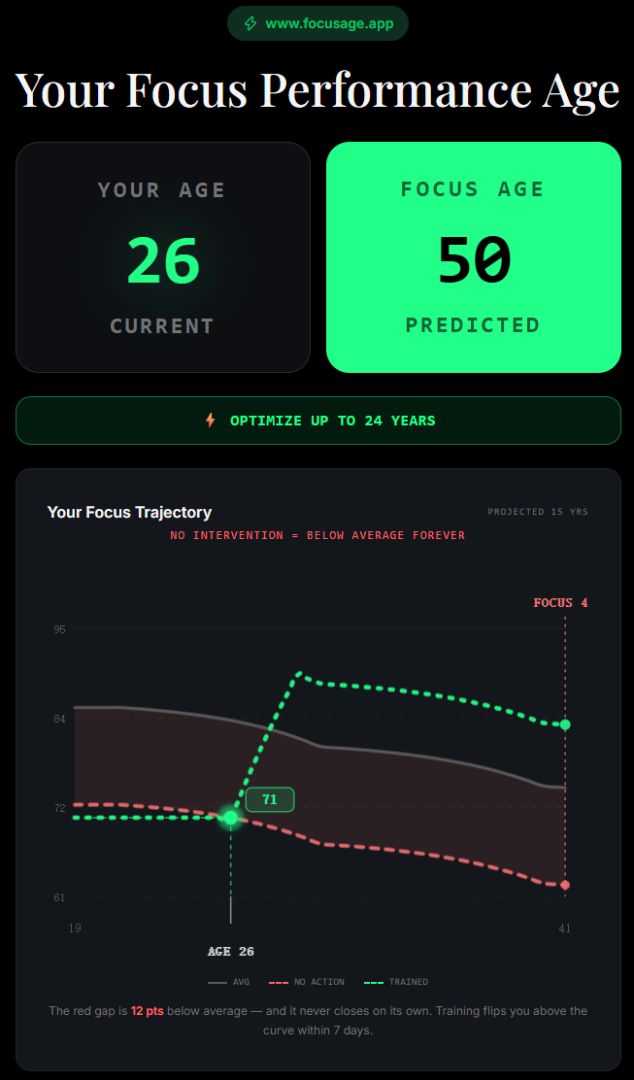
A 3-minute Focus Performance Age challenge. See how your focus, memory, and reaction time compare against age-group benchmarks.
The basics
What is a reaction time test?
A reaction time test measures the gap in milliseconds between seeing a stimulus and responding to it. This one asks you to tap the instant the screen turns green, across five trials — your median result is your reaction time.
Simple reaction time
One stimulus, one response. Nothing to decide, only to detect. This is the kind of reaction time test you just took, and the kind every published benchmark is built on.
Choice reaction time
Several stimuli, each with its own response. The extra decision step costs roughly 100 ms, so these scores always read slower than a simple reaction time test.
On a first attempt, most adults land somewhere between 250 and 300 ms when they take a reaction time test in a browser. A handful of further attempts usually shaves off another 10–30 ms, mostly because the movement itself becomes familiar rather than because anything has improved. Anything below about 170 ms is almost certainly a lucky guess rather than a real response — the nerve signal cannot get from your eye to your finger faster than that.
What actually moves your score
Alertness. Sleep, caffeine and time of day shift simple reaction time by 10–30 ms on their own.
Anticipation. Guessing the cue lands you below 150 ms — faster than human nerve conduction can physically go.
Hardware latency. A 60 Hz screen and a wireless mouse routinely add 20–40 ms before your finger is involved.
Compare like with like. The only way to track a genuine change is to run the five trials under the same conditions each time — the same device, roughly the same hour of day, and your hand already resting on the mouse or screen before the first cue appears.
Full reaction time test methodologyYour result in context
Average reaction time by age
Simple visual reaction time is fastest in the late teens and then slows by roughly 1–1.5 ms per year. Here is what the median looks like by age group — find your band and compare your own millisecond score.
| Age group | Median reaction time |
|---|---|
| 16-19 | 232 ms |
| 25-29 | 247 ms |
| 40-44 | 273 ms |
| 55-59 | 315 ms |
| 60+ | 335 ms |
| All adults | 270 ms |
These medians already include the latency of an ordinary browser, screen and mouse, which is why they sit slightly above the classic laboratory numbers. Half of people in each age group score faster than the figure shown.
Read your own number against the median rather than in isolation. A score of 285 ms is comfortably better than average in the 55–59 band, while the same 285 ms would be well below par at 20–24. Scores also drift from day to day, so take the reaction time test several times across a few days and judge yourself on the middle of those runs rather than on your single best result — chasing a personal best mostly measures how well you guessed the cue.
Full average reaction time benchmarks and percentilesGo faster
Train your reaction time
Reaction speed responds to practice, and not only by tapping faster. These eight free reaction time and reflex drills train the three things that sit underneath every millisecond you shave off: visual processing speed, sustained attention, and anticipation control.
Reaction Age
Five green-screen trials, scored in milliseconds.
Focus Sprint
Track a target through random collisions.
Speed Scan
Timed visual search with an accuracy penalty.
Reverse Hunt
Find 25 down to 1 against the clock.
Count the Boxes
Count the shapes before the flash fades.
Moving Memory
Track two marked dots among five in motion.
Memory Lift
Progressive digit-span intervals.
Box Breathing
Guided 5-3-5-3 breathing to reset alertness.
Expect the first improvement inside two weeks, though almost all of it at that stage comes from learning when the cue is likely to arrive rather than from genuinely faster nerves. The durable change is slower and smaller — something in the region of 10–20 ms off your reaction time after a month of steady practice, which then holds as long as you keep training. Ten milliseconds is still enough to move you a whole band in the table above.
Browse all reaction time drills